Sarah had been waiting for months.
Her UK visa application was finally ready. She had everything — passport, bank statements, birth certificate, marriage certificate. She found a translator online, paid the fee, and sent everything off to the Home Office.
Two weeks later, a letter arrived.
Rejected.
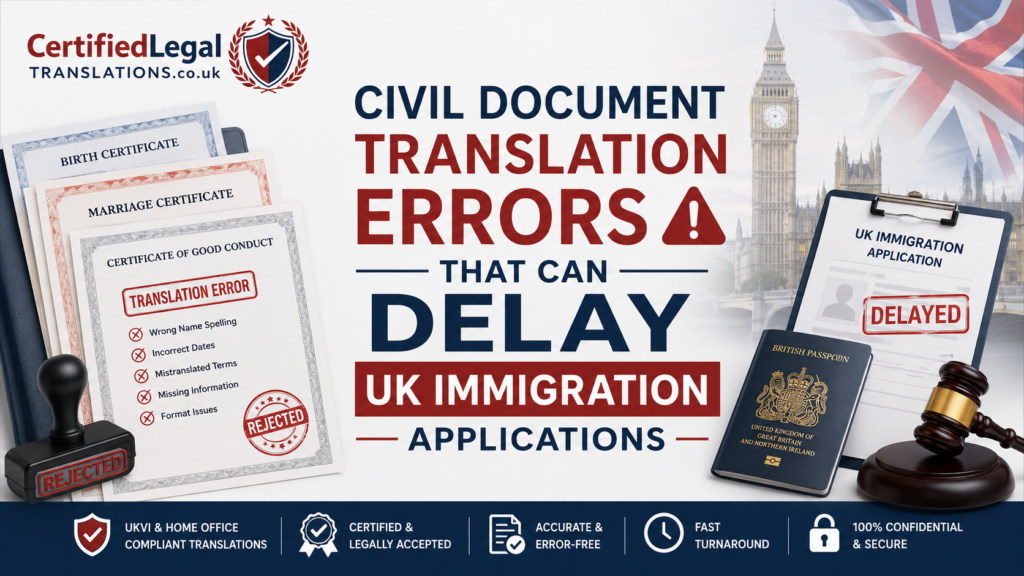
Not because of her background. Not because of her finances. But because her translated documents did not meet UK standards. The translator had missed a certification statement. The format was wrong. One name was spelled differently on two documents.
She had to start the whole process again. This is not a rare story. Every single week, hundreds of people across the UK face the same situation. Their visa applications, court submissions, university enrolments — all delayed or rejected because of problems with their translated documents.
The painful truth is that most of these rejections are completely avoidable.
In this guide, we will explain exactly why UK authorities reject translated documents. We will go through the most common mistakes, which authorities are the strictest, what happens after a rejection, and what you can do to make sure your documents are accepted the first time.
Who in the UK Can Reject Your Translated Documents?
Before we talk about why rejections happen, it helps to understand who is actually doing the rejecting.
In the UK, many different authorities review translated documents. Each one has its own standards. Each one looks for slightly different things. And each one has the power to refuse your application if something looks wrong.
Home Office and UKVI
The Home Office — and its immigration arm, UKVI — is the most common source of rejection for translated documents. Visa applicants, people applying for leave to remain, and those going through settlement or naturalisation all have to submit translated supporting documents.
UKVI is strict. The translation must include the translator’s full name, their contact details, their signature, the date the translation was completed, and a statement confirming that the translation is accurate and complete. If any of these details are missing, the document will be returned.
UK Courts
Courts require translations that are precise. Legal language is very specific. If a term is translated incorrectly — or if the translator uses informal language where formal legal terminology is required — a judge or solicitor can challenge the document. Courts also expect the translation to follow a format that matches the original document closely.
FCDO — Foreign, Commonwealth and Development Office
The FCDO deals with documents that need apostilles and legalisation. If a translated document is submitted for legalisation and it does not meet the required standards, it will be refused.
UK Universities
Universities reviewing international applications check translated academic transcripts, diplomas and certificates. They look for professional formatting, accurate grade conversion and proper certification. Poorly translated academic records can result in an application being put on hold.
Other Bodies — DVLA, GMC, GDC, NMC, Councils
Professional licensing bodies like the General Medical Council and the Nursing and Midwifery Council check translated qualifications from overseas. Local councils review documents for housing, benefits and registration purposes. The DVLA requires translations of driving licences from certain countries.
Each of these bodies has its own checklist. And most rejections happen simply because the person submitting the documents did not know exactly what that checklist required.
Common Mistakes That Get Legal Translations Rejected
This is the most important section of this blog. These are the actual reasons documents get sent back — not vague reasons, but the specific problems that cause rejections day after day.
1. The Certification Statement Is Missing or Incomplete
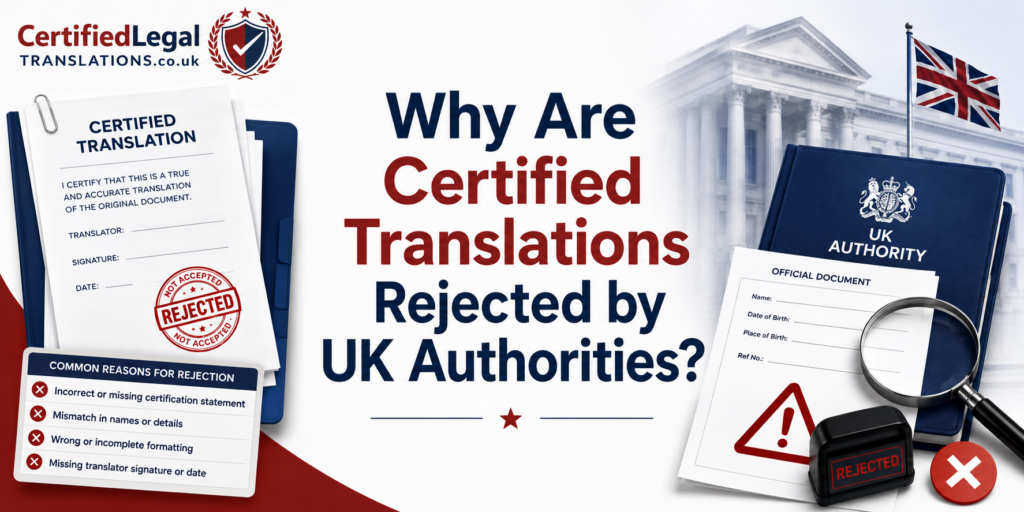
This is the single most common reason for rejection. A certified translation is not just a translated document. It must include a signed statement from the translator confirming that the translation is accurate and complete.
This statement must include:
- The translator’s full name
- Their contact details
- Their signature
- The date the translation was completed
- A declaration that they are competent to translate between the two languages
If this statement is missing — or if it is incomplete — the document is not considered certified. Full stop. UKVI and the Home Office will return it immediately.
Many people assume that just having a stamp or a letterhead makes a translation certified. It does not. The written declaration is what makes it official.
2. The Translator Is Not Qualified
UK authorities do not require translators to be registered with a specific body. However, they do expect the translator to be a professional with clear competence. If the person who translated your document has no verifiable credentials — no professional history, no relevant qualifications, no way to confirm their identity — the translation may be questioned.
Some authorities, particularly courts and legal firms, prefer translators who are members of the Chartered Institute of Linguists or the Institute of Translation and Interpreting. Using a qualified, experienced translator reduces the risk of rejection significantly.
3. Names and Personal Details Do Not Match
This is a surprisingly common mistake. A person’s name might be spelled one way in their passport and slightly differently on a birth certificate — perhaps because of a different transliteration from another script. If the translated document uses a spelling that does not match the other documents in the application, it raises a flag.
The same applies to dates of birth, addresses and other personal details. Even a single digit wrong in a date can cause the entire application to be paused for manual review.
4. The Formatting Does Not Reflect the Original
UK authorities expect the translated document to mirror the layout and structure of the original as closely as possible. If the original document has sections, boxes, stamps, headings or seals, the translation should reflect these clearly.
A translation that is just a block of text with no structure — even if the words are accurate — can be questioned. Officers reviewing the document need to be able to compare the original and the translation side by side. If the structure is completely different, this comparison becomes difficult and suspicion increases.
5. Sections of the Document Are Not Translated
Some translators skip sections that seem unimportant — small print, standard terms, official stamps or handwritten notes. But UK authorities want the full document translated. If something is left out, it should be noted explicitly in the translation, with an explanation such as “stamp illegible” or “handwriting not translatable.”
Leaving sections blank without explanation suggests either carelessness or an attempt to hide information. Neither impression is helpful to an applicant.
6. The Quality of the Scan Is Poor
This is not a translation error, but it causes rejections just as often. If the original document provided to the translator is blurry, dark, cut off or illegible in places, the translation will reflect those gaps. And when UKVI or a court sees a translation with missing words or unclear sections, they will ask for the document to be resubmitted.
Always send clear, high-resolution scans. Both the original and the translation should be easy to read from start to finish.
7. Wrong Language Pair Listed
Translations must clearly state which language the document was translated from and which language it was translated into. If this information is missing or incorrect — for example, listing “Persian” when the document is actually Dari — it raises questions about the quality of the entire translation.
8. No Signature or Date on the Certification
A certification statement without a date is incomplete. A certification statement without a signature is invalid. Both must be present. Some translators forget to include the date, thinking it is a minor detail. It is not. UKVI case workers check for this specifically.
Why Do These Translation Errors Keep Happening?
Knowing the mistakes is one thing. Understanding why they keep happening helps you avoid falling into the same trap.
People choose the cheapest option available
When someone is already paying hundreds or thousands of pounds on a visa application or legal case, the cost of translation can feel like a burden. So many people look for the cheapest option — a freelancer on a job board, a bilingual friend, or an automated service.
The problem is that cheap translators often have no experience with official UK document requirements. They may produce a perfectly readable translation that is still completely wrong in format and certification terms.
Online tools do not meet UK standards
Machine translation tools like Google Translate or DeepL can produce impressive results for casual reading. But they produce no certification statement, no translator credentials, no signature and no date. No UK authority accepts machine-translated documents for official purposes. Ever.
People do not know what the requirements are
Most people applying for visas or submitting documents to courts are not translation experts. They assume that if a document says “certified” on it, it is good enough. But certification means something very specific in the UK context, and without knowing exactly what that looks like, it is easy to submit something that falls short.
The translator does not specialise in UK legal requirements
A translator who is fluent in two languages and even highly experienced in translation may still be unfamiliar with the specific formatting, wording and certification requirements used by the Home Office, UKVI or UK courts. Legal translation for UK purposes is a specialism in itself.
What Happens After a Document Rejection by UK Authorities?
Rejection is not just frustrating. It has real consequences.
Delays to your application
Once your documents are rejected, you have to start the submission process again. Depending on the authority, this can mean waiting weeks — or even months — for your case to be reviewed again. For visa applicants, this can mean missing travel dates, job start dates or family events.
Financial cost
In most cases, application fees are not refunded because of a document error. That means if your visa application is rejected due to a translation problem, you lose the application fee and have to pay again on resubmission. Added to the cost of getting new translations done correctly, the total financial impact can be significant.
Stress and uncertainty
Beyond the money and the time, there is the personal impact. People dealing with immigration applications, court cases or professional registration are already under pressure. A rejection because of a document error adds unnecessary stress on top of an already difficult process.
In some cases, missed deadlines cannot be recovered
If a court deadline is missed because a translation was rejected, that can have serious legal consequences. Some deadlines cannot be extended. Some applications have time limits that expire. Getting it right the first time is not just convenient — in some situations, it is critical.
How to Get Your Official Translation Accepted First Time
The good news is that all of these problems are avoidable. Here is what you need to do.
Use a professional translator who knows UK requirements
Do not just hire someone who speaks two languages. We at Certified Legal Translation UK specifically understand what UK authorities require. Our translators know the correct format for the certification statement, the right terminology for legal and immigration documents, and the formatting standards expected by UKVI and courts.
Check that the certification statement is complete
Before you submit anything, check that the translation includes a full certification statement with the translator’s name, contact details, signature and the date. If any of these are missing, go back to the translator before you submit.
Make sure names and dates match across all documents
Go through your full application and compare every name and date across every document. Even small differences — a middle name included on one document but not another, a date formatted differently — can trigger a manual review.
Send high-quality scans
Photograph or scan your documents in good lighting. Make sure every corner is visible, every stamp is readable and every line of text is clear. Poor image quality is one of the most easily avoidable causes of rejection.
Match the format of the original document
If your original document has sections, headings or boxes, your translated version should reflect the same structure. Your translator should be doing this automatically — but check before you submit.
Ask your translator about their experience with your specific authority
If you are submitting to UKVI, ask whether the translator has produced UKVI-accepted translations before. If you are submitting to a court, ask about their experience with legal document translation. Experience with the specific authority matters.
Conclusion
Getting a translation rejected by a UK authority is one of those problems that feels small until it happens to you. Then suddenly it means weeks of delay, extra costs, and the frustration of knowing the problem was completely avoidable.
The reasons UK authorities reject translated documents are almost always the same: missing certification, poor formatting, unqualified translators, name mismatches or incomplete documents. None of these are complicated issues. They are all things a professional, experienced translation service will handle correctly from the start.
If you have documents that need to be translated for the Home Office, UKVI, a UK court, a university or any other official body, do not leave it to chance.
At Certified Legal Translations UK, every translation is prepared to meet the exact standards required by UK authorities. Our work includes a complete certification statement, correct formatting, qualified translators, and a quality check before delivery. We have handled over 12,000 documents with a 98% first-time acceptance rate.
Get a free quote today. Upload your document and we will take it from there.