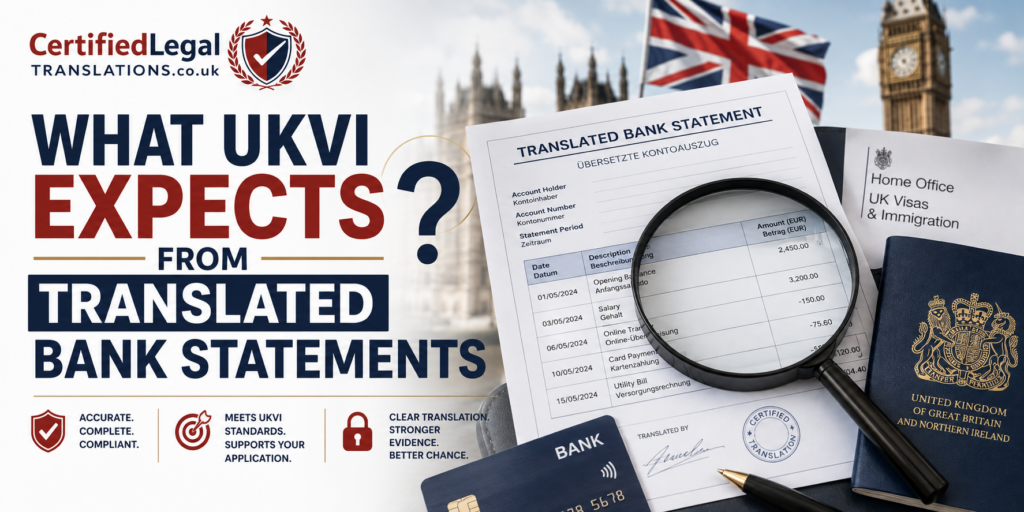
Lucía moved to the UK from Spain to join her husband. For her partner visa, she had to prove her savings. Her Spanish bank statements showed every euro she had put aside. To save money, she translated them herself and uploaded the file. Weeks later, the refusal landed. Her translation was not certified, and several transaction lines were missing. Months of saving, undone by one document. This is why getting a bank statement translation for a UK visa right matters.
Bank statements sit at the heart of many UK visa applications. They prove you meet the income or savings rules. But UKVI does not only check the numbers. It checks how the translation is done. One wrong step, and a strong financial case can still fail.
This guide shows you how to translate bank statements for a UK visa the right way. You will learn the exact UKVI translation rules for bank statements — certification, accuracy, currency, and submission. And where a certified translator is required, we Certified Legal Translations handles the paperwork to UKVI standard, so nothing is left to chance. Follow these rules, and your money is proven cleanly, first time.
Certification Details Every Bank Statement Translation Needs
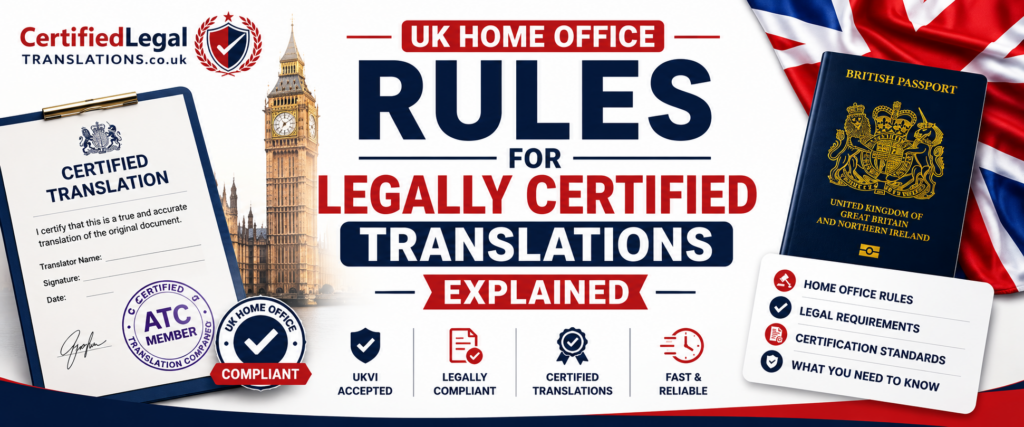
UKVI accepts your translation only if it is certified the right way. Four details must appear on the document. Together, these are the home office approved translation criteria your caseworker checks.
Your certified translation must include:
- Accuracy confirmation — a clear line stating it is a true and accurate translation of the original.
- Date — the exact date the translation was completed.
- Translator details — the translator’s full name, signature, and contact details.
- Credentials — for applications made inside the UK, the translator’s or company’s professional membership and qualifications.
Get these four right, and your bank statement translation meets the standard. Miss one, and the file can bounce back.
These points sit at the core of the UKVI translation rules for bank statements. They also reflect the wider home office bank statement translation guidelines. They apply whether your statement is one page or thirty. The rule does not bend for a “simple” document.
Choosing An Independent Translator For Your Statements
Here is the mistake that sinks the most applications: can I translate my own bank statement for a UK visa? The answer is a firm no. Your English could be flawless, and UKVI still will not accept it.
The translation must be independent. That means these people cannot do it:
- You, the applicant — even if you are fully bilingual.
- Family or friends — no blood relative or partner can sign it.
- A visa agent — unless they are also a qualified, certified translator.
Why so strict? A bank statement proves your money. UKVI needs someone neutral to confirm it, with nothing to gain from your visa. So the job goes to a professional translator or a registered agency.
For anything money-related, an independent expert is not optional. It is the difference between an accepted file and a wasted fee.
Translating Every Line And Matching The Layout
A summary is not enough. This trips up even careful applicants. UKVI wants a full, word-for-word translation of the whole statement.
That means every part must appear in English, including:
- Every transaction line, date, and amount
- Bank logo text and headers
- Table headings and column titles
- Stamps, seals, and any notes
- Page numbers and footers
Translating only the final balance or a header can get a visa refused on the spot. Nothing can be skipped or shortened.
Layout matters just as much. The translation should mirror the original bank statement, in the same tabular format. Rows, columns, and dates should line up side by side. This lets the caseworker compare both copies in seconds. These uk visa document translation requirements keep your evidence clear and easy to trust. Handling every line and stamp correctly is exactly what our bank statement translation service manages every day.
Handling Foreign Currency And Exchange Rate Conversion
Here is a rule that surprises almost everyone. Your translator must not convert your money into pounds. The amounts stay in the original currency — euros, rupees, dirhams, whatever your statement shows.
Why?
Because converting is not the translator’s job. If your translator changes euros into pounds, they risk adding an error. That can raise doubts about the whole document.
So who does the maths?
UKVI does it. The caseworker uses the official OANDA.com exchange rate, set to the date of your application. They convert your balance using that rate, not the translator’s.
You can check the current financial requirements and currency conversion rules in the official UK Government guidance.
This is one of the most missed points in bank statement translation. Keep the currency original, let the caseworker convert, and your figures stay accurate. It protects you from a refusal over a simple rounding slip.
Submitting Your Original And Translated Statements Together
Even a perfect translation fails if you submit it wrong. UKVI wants to see both documents, not just the English one.
When you upload, follow these habits:
- Send both files. Attach the original bank statement and the certified translation together.
- Name them clearly. Label each file so the caseworker can match original to translation at a glance.
- Keep them paired. Where possible, group each statement with its translation in one clear set.
A translation on its own looks incomplete. The caseworker cannot verify a figure they cannot trace back to the source. Sending both, clearly named, removes that doubt. It is the final step that keeps your financial evidence solid.
Bank Statement Translation for UK Visa Checklist
This checklist turns the UKVI translation rules for bank statements into simple steps. Run through this quick certified translation for uk visa checklist before you upload:
- The translation is certified, not done by you or a relative.
- All four certification details are present — accuracy line, date, translator details, credentials.
- Every transaction, header, stamp, and page number is translated.
- The layout matches the original, in the same table format.
- Amounts stay in the original currency, with no conversion.
- The original and translation are ready to upload together, clearly named.
If every box is ticked, your statement is ready. If not, fix it before you apply — you often cannot add documents later.
Short on time or unsure? Our Home Office certified translation service runs this exact checklist for you, so nothing is missed.
Faq’S
Does Ukvi Accept A Digital Signature On A Translation?
Usually, yes. UKVI does accept digital translation signatures, as long as the translation is clearly certified. The signature must link to a named, contactable translator. The risk is a typed name with no real certification behind it — not the digital format itself.
Do Bank Statements Need To Be Notarised For A Uk Visa?
No. A standard UKVI application does not need a notary. Professional certification by a qualified translator is enough. A notary stamp on a bank statement translation adds cost, not acceptance.
Do I Need To Translate A Statement That Is Already In English?
No. If your bank issues statements in English, no translation is needed. But if even the headers, stamps, or notes are in another language, those parts must be translated.
How Many Months Of Bank Statements Does Ukvi Want Translated?
Translate every statement you submit as evidence. Many financial routes ask for around six months of history. Whatever period you include, each page in that set must be fully translated and certified.
Can I Use Online Banking Screenshots Instead Of Official Statements?
Only if they meet UKVI’s evidence rules. Screenshots often lack official formatting and full bank details. If they are accepted, they still need the same full, certified translation as a formal statement.
Will A Bank Statement Translation Done In My Home Country Be Accepted?
Yes, if it meets the UK’s rules. It must be in English, certified, and show the translator’s name, signature, and contact details. A foreign “sworn” stamp on its own is not enough for UKVI.
Conclusion
Follow the UKVI translation rules for bank statements, and your financial evidence does its job. Keep it certified, word-for-word, and in the original currency. Send the original beside the translation, clearly named. That is how bank statements pass UKVI cleanly.
You do not have to do this alone. We have translated thousands of bank statements that met UKVI financial requirements in first attempt. We cover 40+ languages, with a 98% first-time acceptance rate.
The easiest way to start is right here. Use the form on this page to upload your bank statement. Attach a clear scan or photo, tell us your deadline, and send it over. We will reply fast with a quote and a turnaround time — at no cost, and no pressure.
One upload is all it takes. Send us your statement now, and get a certified translation UKVI will accept.