⚡ Quick Answer: HM Land Registry requires every document submitted for property registration in England and Wales to be in English, so a foreign-language title deed, sale contract or supporting document needs a certified translation before a solicitor can complete the purchase. Overseas buyers typically need certified translations of the title deed, sale agreement, proof of ID and address, and proof of funds, while a Power of Attorney used to buy remotely usually needs a notarised translation rather than certified alone. Buyers using an overseas company must also register with the Register of Overseas Entities at Companies House before the property can be registered.
Buying property in the UK from abroad already involves enough moving parts — currency transfers, time zones, a solicitor you’ve likely never met in person. What catches overseas buyers out is assuming their existing paperwork, whatever language it’s in, will simply carry over into the UK system.
At Certified Legal Translations, we regularly prepare document sets for non-resident buyers whose purchase stalled at exchange, not because anything was wrong with the property, but because a document reached the solicitor’s desk in the wrong format.
📌 KEY TAKEAWAYS
- ✔ HM Land Registry accepts English-language documents only — there’s no partial exception for a document that’s “mostly” in English.
- ✔ Title deed, sale contract, ID, proof of address and proof of funds all typically need certified translation.
- ✔ A Power of Attorney used for a remote purchase usually needs a notarised translation, a stricter standard than the rest of the file.
- ✔ Buying through an overseas company adds a separate Register of Overseas Entities step before HM Land Registry will register the property.
Why Hm Land Registry Won’T Register Your Property Without An English Translation
HM Land Registry’s requirement is absolute: every document submitted for registration has to be in English. There’s no partial exception for a title deed that’s “mostly understandable” or a contract where only the schedule is in another language. If any part of what you’re submitting isn’t in English, the whole submission can be held up until a certified translation is provided.
What solicitors rarely explain to first-time overseas buyers is that this isn’t a formality the registry applies loosely — it’s the working basis on which the registration examiner checks your ownership claim. A translation with a gap, a mismatched name, or a missing certification statement gets treated the same way an incomplete original document would.
The Property Document Requirements Matrix For Overseas Buyers
Not every document in your purchase file needs the same treatment, and the standard required often surprises buyers used to a single “certified” tier covering everything.
| Document | Certification Level Needed | Who Requires It | Where Buyers Get Caught Out |
|---|---|---|---|
| Title deed / existing ownership document | Certified | HM Land Registry | Assuming a partial translation of just the key clauses is enough |
| Sale / purchase contract | Certified | Solicitor, HM Land Registry | Schedules and annexes left untranslated because they “aren’t the main text” |
| Passport / national ID | Certified | Solicitor (AML checks) | Submitting the translation without the certified original attached |
| Proof of address | Certified | Solicitor (AML checks) | Using a document older than the solicitor’s acceptable date range |
| Proof of funds / source of wealth | Certified | Solicitor, mortgage lender | Underestimating how much detail the source-of-funds evidence needs to show |
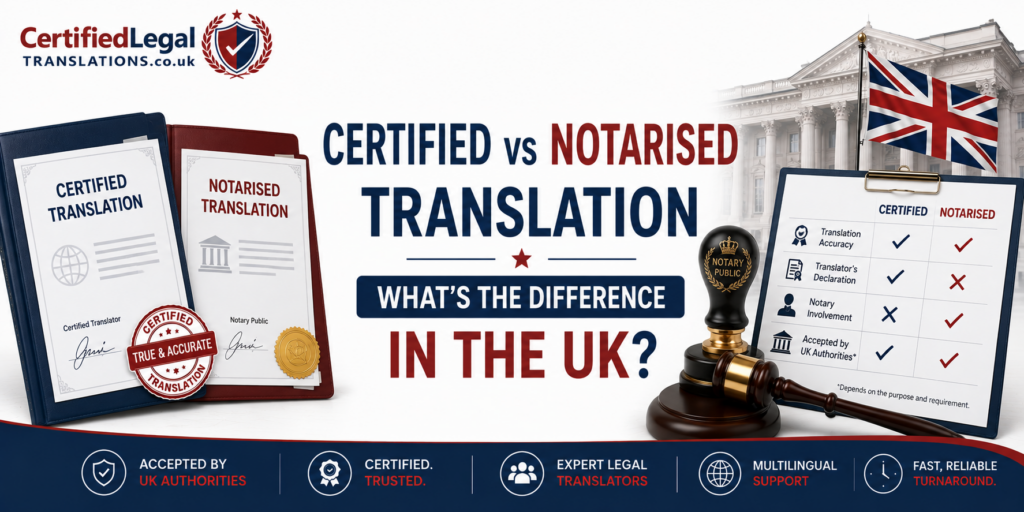
| Power of Attorney (remote purchase) | Notarised | HM Land Registry, solicitor | Assuming certified alone is sufficient, the same as the rest of the file |
What Actually Happens When Property Documents Aren’T Translated Correctly
The consequences rarely show up at the point everyone expects. In our experience, the purchase doesn’t collapse at the offer stage — it stalls right before exchange, when the conveyancing solicitor is assembling the final document set and discovers a foreign-language document has no certified translation attached, or the translation that does exist doesn’t meet the certification standard the registry expects. A translation prepared informally — by a bilingual friend, a relative, or a general translation app — is not accepted for Land Registry submission or by most conveyancing solicitors, and the entire filing can be rejected outright.
Title Deeds And Sale Contracts Need More Than Word-For-Word Accuracy
A title deed carries specific legal language around ownership, boundaries and any registered charges or restrictions. Translating it accurately means preserving that legal effect, not simply converting the words — a translator without legal-document experience can render the sentence correctly while still losing the precise meaning of a covenant or an easement referenced in the original.
Identity And Funds Documents Exist For Anti-Money Laundering Compliance
Every UK conveyancing solicitor has a statutory obligation to verify who they’re acting for and where the purchase money has come from. If your passport, proof of address or bank statements are in a foreign language, the solicitor can’t complete those checks without a certified translation — and under current AML rules, they’re not permitted to proceed with the transaction until they can.
Buying Remotely Or Through An Overseas Company: Two Extra Layers To Plan For
If you can’t be in the UK to sign personally, a Power of Attorney lets your solicitor or a trusted representative complete the purchase on your behalf. What surprises most overseas buyers is that HM Land Registry and conveyancing solicitors generally expect a notarised translation of a foreign Power of Attorney, not just a certified one — the added step of a notary verifying the translator’s signature carries more weight where someone else is legally signing on your behalf.
Purchasing through a company or trust structure rather than your own name adds a separate registration step too. Overseas corporate buyers must register with the Register of Overseas Entities at Companies House before the property can be registered at HM Land Registry, and any foreign-language constitutional documents supporting that registration need their own certified translation, running alongside the property document translations above rather than replacing them.
Getting Your Property Documents Ready Before You Instruct A Solicitor
- ✔ Identify every document in a foreign language early.
Title deed, contract, ID, proof of address, proof of funds — list them before your solicitor asks, so nothing surfaces late in the process. - ✔ Confirm whether you’re buying personally or through a structure.
A company or trust purchase adds registration steps most individual buyers never encounter. - ✔ Check if a Power of Attorney is involved.
If you won’t be in the UK to sign, budget time for a notarised translation, not just a certified one. - 📌 Commission certified translations for everything else.
Complete, professionally certified translations — not summaries — for the title deed, contract and supporting AML documents. - 📌 Send translations to your solicitor alongside the originals.
A translation submitted without its source document is treated as unverifiable by most conveyancers. - 📌 Build translation time into your completion timeline.
Leaving this until exchange is imminent is the single most common reason overseas purchases slip their date.
Our property deed translation service covers exactly this document set, prepared to the standard HM Land Registry and conveyancing solicitors expect from the first submission.
Frequently Asked Questions
Does Every Document In Our Purchase Need To Be Notarised, Not Just Certified?
No. Most property documents — the title deed, contract, ID and proof of funds — only need certified translation. Notarisation is generally specific to a Power of Attorney used for a remote purchase, not the rest of the file.
Can Our Solicitor Accept A Translation We Arranged Ourselves In Our Home Country?
Sometimes, if it meets UK certification standards — a signed statement of accuracy, the translator’s name and contact details, and the date. Confirm with your solicitor before relying on it, since some prefer a UK-based provider familiar with Land Registry formatting.
How Long Does Certified Translation Add To A Property Purchase Timeline?
It depends on document volume and language, but same-day and urgent turnaround is available for most property document sets. The bigger delay risk is leaving translation until the last minute rather than the translation itself taking long.
Do We Need A Certified Translation If Our Documents Are Only Partly In English?
Yes. If any section, stamp or schedule is in another language, HM Land Registry expects the full document translated, not just the parts already in English.
Get Your Property Documents Certified For A Uk Purchase
Whether you’re buying personally, through a Power of Attorney, or via an overseas company structure, your solicitor needs every foreign-language document translated and certified before exchange can move forward. Send us your title deed, contract and supporting documents, tell us your completion date, and our specialists will confirm exactly what your solicitor needs.
Get Your Property Documents Translated and we’ll come back with a turnaround time the same day.