⚡ Quick Answer: A certified translation in the UK carries a signed statement of accuracy from the translator or agency confirming the English text is a true and complete rendering of the original — there is no government licensing body behind it. A notarised translation adds a UK notary public’s verification of the translator’s identity and signature, not the accuracy of the translation itself. The UK has no sworn translator system in the continental European sense; certification and notarisation are the two recognised standards, and which one you need depends entirely on what the receiving body has asked for.
Most confusion around UK translation certification doesn’t come from the documents themselves — it comes from people arriving with expectations shaped by a completely different legal system.
At Certified Legal Translations, we regularly speak with clients from Spain, France, Germany and elsewhere who ask for a “sworn translator” and are surprised to learn that concept doesn’t exist here in the way they expect. In our years of preparing certified and notarised work for UK authorities, courts and receiving bodies abroad, the confusion is almost never about the translation quality itself — it’s about which legal mechanism actually applies to their situation.
Understanding why takes explaining how UK certification actually works as a legal framework, not just which box to tick on a form. This guide sets out what certified and notarised translation actually mean as legal concepts, why the UK never adopted a sworn translator system, and what each standard genuinely carries in terms of legal weight if it’s ever challenged.
Why The Uk Has No Sworn Translator System
Civil law countries — Spain, France, Germany, Italy among them — appoint sworn translators through a court or a government ministry. That translator holds an official seal, is answerable to the appointing authority, and their translations carry a specific legal status simply because of who appointed them, independent of the actual translation work in front of a caseworker or official.
England and Wales never built that structure, because common law jurisdictions generally don’t licence translators as a distinct legal profession the way civil law systems do. Instead, the responsibility sits with the person relying on the translation to ensure it’s accurate and properly certified — which is precisely why the certificate of accuracy carries the weight it does here. It’s not a government stamp of approval; it’s a professional declaration the translator is personally accountable for, and that accountability is what a receiving body is really evaluating when they check a certificate.
What People Assume Vs What The Uk Framework Actually Requires
💡 PRO TIP: If you’re used to a civil law jurisdiction, stop looking for the UK equivalent of a “sworn translator” register — it doesn’t exist. Look instead for a translator or agency with genuine professional membership and ask directly what certification standard your receiving body has requested.
| Common Assumption | What the UK Framework Actually Says |
|---|---|
| “A certified translation needs a government-approved translator” | There’s no licensing body — certification is a professional declaration made by the translator or agency themselves, backed by their own accountability |
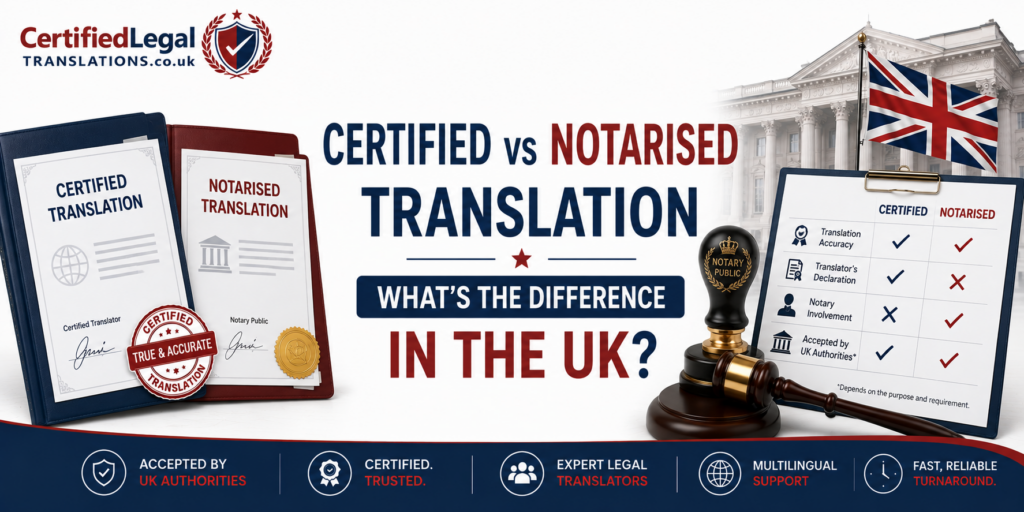
| “Notarisation checks that the translation is accurate” | A notary verifies the translator’s identity and witnesses their signature — they do not check or vouch for the accuracy of the translation itself |
| “Certified and notarised are just two names for the same thing” | They’re separate legal acts serving different purposes, and one doesn’t substitute for the other if a specific body has asked for the other |
| “Any translator can add ‘certified’ to their work” | Nothing stops the words appearing on a document, but a certificate without genuine professional accountability behind it carries little weight if challenged |
What “Certified” Actually Means As A Legal Concept
A certified translation rests on a signed statement of accuracy — the translator or agency formally declaring that the English text is a true and complete rendering of the original, with their name, contact details and the date attached. Legally, this functions as a professional declaration, not a licensed act. If the translation is later challenged, the certificate is what ties a real, contactable person to the accuracy claim, which is why a thin or anonymous certificate collapses under scrutiny far more easily than a signed one from an established provider.
Who Can Legally Certify A Translation In The Uk
There’s no statutory requirement to hold a specific qualification before certifying a translation, which surprises people used to licensed professions. In practice, though, receiving bodies look for membership of a recognised professional body — the Institute of Translation and Interpreting (ITI), the Chartered Institute of Linguists (CIOL), or delivery through an Association of Translation Companies (ATC) registered provider. None of these confer a legal licence in the way a solicitor or notary holds one; they demonstrate that the translator has been vetted against a professional standard, which matters enormously if a certificate is ever questioned.
What “Notarised” Adds That Certification Doesn’T
Notarisation introduces a genuinely separate legal act into the process. A UK notary public witnesses the translator signing their certificate and verifies the translator’s identity, then adds their own seal confirming that verification took place. What the notary does not do is check the translation’s accuracy, compare it against the original, or vouch for the translator’s competence — that responsibility stays with the translator alone.
What A Notary Checks, And What Stays The Translator’S Responsibility
This distinction matters because it’s routinely misunderstood: notarisation raises the evidential weight of who signed the certificate, not the quality of what was translated. A poorly translated document notarised by a UK notary is still a poorly translated document — the notary’s seal confirms identity, nothing more. Where a receiving body specifically wants that extra layer of identity verification, our notarised translation service adds it correctly, without implying the notary has reviewed the translation itself.
The Legal Weight Each Carries If Challenged
If a certified translation is disputed, the challenge usually targets the translator’s competence or the accuracy of specific wording — and a translator with genuine professional membership is harder to successfully challenge than one without, because there’s a real accountable person and a professional body standing behind the work. If a notarised translation is disputed, the identity verification behind the signature is rarely in question; what can still be challenged is the accuracy underneath it, because notarisation was never designed to resolve that question in the first place. A well-notarised translation of a poorly done original is still vulnerable on exactly the same grounds it would be without the notary’s seal.
Choosing the wrong level for your situation carries a real practical cost either way. Requesting notarisation nobody asked for adds unnecessary time and expense, sometimes doubling the turnaround for no legal benefit. Submitting only a certified translation where notarisation was specifically required can see the whole document rejected, regardless of how accurate the underlying translation is — which is the more common and more frustrating mistake we see.
Before You Choose A Certification Level
- Confirm exactly what the receiving body has requested, in their own written wording, rather than assuming
- Check whether the translator or provider holds genuine professional membership (ITI, CIOL, or an ATC-registered agency)
- Understand that notarisation verifies identity, not translation accuracy — don’t pay for it expecting the latter
- Where the requirement is unclear, ask the receiving body directly rather than guessing and risking rejection
Frequently Asked Questions
Is A Sworn Translation The Same As A Certified Translation In The Uk?
No. Sworn translation is a civil law concept involving a court-appointed translator, which the UK doesn’t operate. A UK certified translation achieves a broadly similar purpose through a signed professional declaration instead.
Does Notarising A Translation Make It More Accurate?
No. Notarisation verifies the translator’s identity and signature, not the accuracy of the translated content. A translation’s accuracy remains entirely the translator’s responsibility, notarised or not.
Can Any Uk Notary Notarise A Translation Certificate?
Generally yes, since notarisation of a signature isn’t specific to translation work, though a notary with experience in this particular process tends to avoid procedural errors that can delay acceptance.
Why Do Some Countries Reject A Uk Certified Translation And Ask For Notarisation Instead?
Some foreign authorities are used to their own sworn or notarised standards and don’t recognise a self-certified declaration as sufficient on its own, so they ask for the added identity verification a notary provides.
Get Clarity On Which Standard Your Document Needs
Choosing between certified and notarised shouldn’t be guesswork, and getting it wrong costs time you often don’t have. Send us your document and tell us who’s requesting the translation, and our specialists will confirm exactly which standard applies before any work begins.
Find Out Which Standard You Need and we’ll come back with a clear answer the same day.