Quick answer: Yes — UKVI requires a certified translation for any birth or marriage certificate not in English or Welsh. The translation must confirm accuracy and carry the translator’s name, signature, date, and contact details. Self-translated or app-translated certificates are rejected on sight.
You’ve booked your UK visa appointment. Your birth certificate and marriage certificate are ready — but they’re in Arabic, Hindi, or Polish. If these documents are not in English or Welsh, you may need a certified translation for UK visas before submitting your application. Then a worry creeps in. Will the Home Office accept them as they are? The short answer is no.
These two documents sit at the heart of almost every UK visa. A birth certificate proves who you are. A marriage certificate proves your relationship. If either is in a foreign language, UKVI needs an official English version before a caseworker can act on it.
This guide explains exactly why these certificates need professional translation for UK visas. We cover the Home Office rules, the six real reasons behind them, the mistakes that cause refusals, and the exact steps to get your documents accepted the first time. If you need professional help, Certified Legal Translations can help you prepare your documents for submission.
Six Reasons Ukvi Demands Certified Certificate Translations
Before the detail, here is the picture at a glance. These are the six reasons your certificates must be professionally translated and certified.
- Legal requirement — the Home Office only accepts documents in English or Welsh.
- Identity proof — your birth certificate confirms your name, date of birth, and parents.
- Relationship proof — your marriage certificate confirms a valid, legal marriage.
- Fraud prevention — the translator’s signature, stamp, and declaration block fake documents.
- Faster decisions — caseworkers who can’t read the original rely on an accurate version.
- Refusal risk — rough or self-made translations get rejected, costing time and fees.
The rest of this guide explains each one, plus the errors that quietly sink applications.
Certified Translation for UK Visas: Home Office Rules
Every UK visa follows the same rule. Any document not in English or Welsh needs a full certified translation. There are no exceptions for birth or marriage certificates.
The home office rules for document translation are specific. According to the official UK government guidance on certifying a document, a certified translation must include:
- a signed statement confirming it is accurate
- the date of translation
- the translator’s full name and signature
- the translator’s contact details
These four points let a caseworker verify the document. You must also submit the original certificate alongside the translation. The Home Office checks one against the other.
Notarisation is not required for a standard application. A solicitor’s stamp is not needed either. A certified translation for UK visas must still meet the required certification standards, including the translator’s declaration, date, signature, and contact details. Meeting the UKVI translation requirements simply means using a professional translator who certifies the work correctly.
Birth and marriage certificates rarely travel alone. Most applicants also submit passports, divorce decrees, or police certificates. Each foreign-language paper follows the same rule. That is why many people bundle everything into one immigration document translation order and keep the certification consistent across the whole file.
Proving Identity And Marital Status Through Translation
A birth certificate does one key job in a visa file. It proves your legal identity. It confirms your full name, date of birth, and your parents’ names. Any error here can break the chain of evidence.
That is why a birth certificate translation for UK immigration must match the original exactly. Names must be transliterated correctly. Dates must follow the UK format. Even a small mismatch can trigger a query. You can see how we handle this on our birth certificate translation service.
Marriage certificates carry different weight. For a marriage certificate translation for a UK spouse visa, the document proves your relationship is genuine and legal. Caseworkers read it closely. A vague or partial version invites doubt. So the translation must reflect every name, date, and official stamp on the page.
Stopping Fraud And Speeding Up Visa Approval
Certified translation also acts as a shield against fraud. Each certified document carries the translator’s signature, stamp, and a signed declaration. This makes it hard to alter or fake. The Home Office trusts it because a qualified professional stands behind it.
Speed matters too. A UKVI caseworker may handle hundreds of files. They rarely read foreign languages. A clear, accurate translation lets them check your certificate in minutes, not days.
The opposite is just as true. A confusing or uncertified document slows everything down. It can trigger extra checks, a request for more evidence, or a refusal. A proper certified translation of a marriage certificate for UKVI removes that friction before it starts.
Common Translation Mistakes That Trigger Visa Refusal
Most translation refusals come from small, avoidable errors. These are the ones we fix most often — and the ones few blogs warn you about.
- Wrong date format. Foreign certificates often use MM/DD/YYYY. UK documents use DD/MM/YYYY. A mismatch confuses caseworkers.
- Blurry stamps or seals. If an official stamp is unreadable, it may be treated as missing. Always scan certificates in clear, high resolution.
- Untranslated seals or notes. Every stamp, seal, and handwritten note must appear in English. Skipping them makes the translation partial.
- Name spelling mismatch. The name on the translation must match your passport. Small transliteration differences cause real problems.
- Missing certification line. Without the signed accuracy statement and contact details, the whole document is invalid.
Each of these looks minor. Yet any one of them can stall a visa. Getting the detail right is what separates an accepted file from a rejected one.
Your Certified Translation Journey From Start To Submission
Here is the simple path from foreign certificate to accepted document.
- Gather every certificate not in English or Welsh.
- Scan each one clearly, front and back, including all stamps.
- Send the scans to a professional certified translator.
- Receive your certified translation with the accuracy statement and signature.
- Check the names, dates, and details against your passport.
- Submit the translation together with the original certificate.
Before you upload anything, run this quick pre-submission check:
- Names match your passport exactly
- Dates use the DD/MM/YYYY format
- Every stamp and seal is translated
- The certification statement, date, and signature are present
- The original certificate is attached
We follow this exact process for every file, including each marriage certificate translation we handle. It keeps your application clean and your timeline short.
Frequently Asked Questions
Can A Bilingual Friend Or Family Member Translate My Certificate?
No. UKVI does not accept translations from you, your family, or anyone with a personal interest in your application. The translation must come from an independent professional the Home Office can contact and verify. A friend’s version, however accurate, will be rejected.
Do I Need To Notarise The Translation For Ukvi?
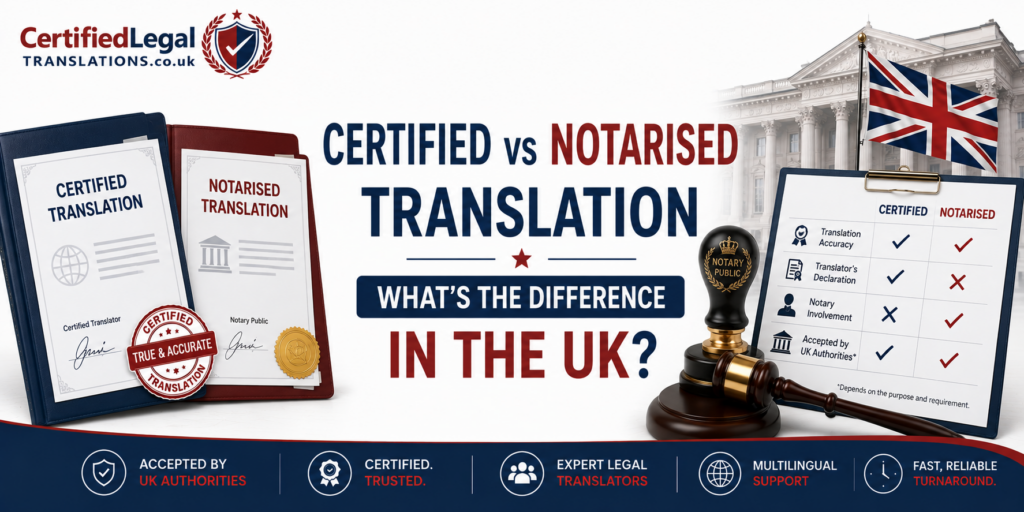
For most visa applications, no. A properly certified translation is enough. Notarisation adds a notary’s stamp and extra cost. Only pay for it if a specific receiving body — such as a court or embassy — asks for it in writing.
Does A Certified Translation Of A Birth Or Marriage Certificate Expire?
The translation itself does not expire. But the original document might. Some routes need recent documents, so an old certificate could still cause issues. The translation stays valid as long as the source document is accepted.
My Name Is Spelled Differently On My Certificate And Passport — Which Spelling Wins?
The translation must reflect the certificate exactly. But a good translator adds a note explaining the spelling or transliteration difference. This stops a caseworker treating it as two different people. Always flag any name variation upfront.
For Settlement Or Ilr, Does The Translator Need Special Qualifications?
Often, yes. In-country routes, such as further leave to remain and settlement, can require the translator to hold recognised credentials. Membership of a body like the CIOL or ITI helps meet this stricter standard under the Immigration Rules.
Can I Get The Translation Done In My Home Country Instead Of The Uk?
You can, if the translator is qualified and certifies the work to UK standards. But a UK-based service lowers your risk. It knows UKVI formatting, uses British English spelling, and can be reached easily by the Home Office if a question comes up.
Conclusion
Birth and marriage certificates are too important to leave to chance. A certified translation for UK visas that meets Home Office rules protects your identity evidence, proves your relationship, and keeps your application moving.
You don’t need to work this out alone. Use the upload form on this page to send us your birth or marriage certificate right now. Attach a clear scan, tell us your visa type, and we’ll return a certified translation ready for UKVI — accurate, signed, and accepted.
With over 15 years of experience, 12,000+ documents translated, and a 98% first-time acceptance rate, your certificates are in safe hands. Upload your documents today and take the guesswork out of your UK visa.