Your hearing date is fixed. Your document sits in Arabic, Polish, Urdu, Romanian or Somali. Someone told you the court needs English, so you paid for a translation and filed it. However, judges do not assess a certified translation for UK courts on how well the English reads. They check whether the paperwork wrapped around it follows the rules.
At Certified Legal Translations we prepare court-bound files every week for litigants in person, solicitors and barristers’ clerks. And the same three failures come back again and again. A certificate missing one detail. An original that never reached the court file. A witness statement built the wrong way round.
So here is what a certified translation for UK courts must contain, what quietly gets your evidence pushed aside, and how to tell the difference before your deadline.
Quick Answer: What A Certified Translation For Uk Courts Must Include
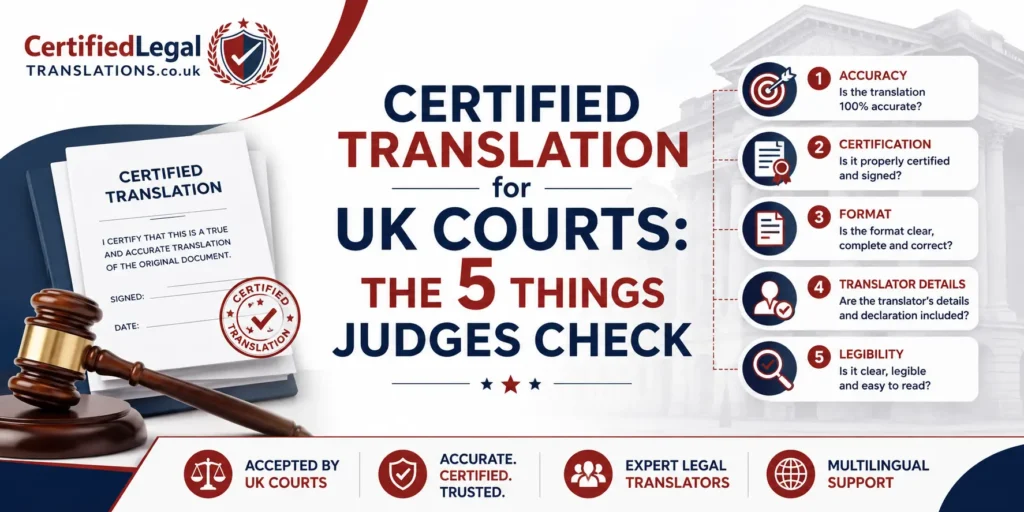
In short, a certified translation for UK courts is court-ready when it carries all five of these elements.
| ✔ | Your court bundle needs this |
|---|---|
| 1 | A signed translator’s certificate of accuracy, confirming the English is true and complete |
| 2 | The translator’s full name, signature, date and contact details on that certificate |
| 3 | The original foreign-language document, filed alongside the English — never the translation alone |
| 4 | For witness statements: the statement drafted in the witness’s own language, signed by the translator |
| 5 | A complete translation — every stamp, seal, margin note and handwritten line accounted for |
Miss one of the five, and the court can still read your document. It just may not rely on it.
Why A Certified Translation For Uk Courts Fails Even When The English Reads Perfectly
Judges are not marking your grammar. Instead, they are testing one thing: can the court trust that the English says exactly what the foreign text says?
That trust comes from procedure, not fluency. In other words, the certificate and the original are what make the translation checkable. Remove them, and the court has no independent way to test the work. As a result, the document carries less weight — or a judge leaves it out altogether.
What A Rejected Court Translation Actually Costs You
The damage is rarely dramatic. In practice, it looks like this:
- Your hearing is adjourned before it starts. Nobody argues the merits. The morning simply disappears.
- Your listing slot goes. The next one may sit weeks or months away.
- The other side may seek costs. An adverse costs order for a wasted day is a real risk.
- Your evidence may be excluded. Then the argument built on that document loses its foundation.
Above all, the client never sees it coming. The English was fine, so nothing looked wrong. Therefore it is worth saying plainly: a rejected certified translation for UK courts is not a quality problem. It is a paperwork problem. We have written separately about the document translation mistakes that delay UK court cases, and almost every one of them is procedural rather than linguistic.
Civil Procedure Rules: The Legal Basis For A Certified Translation For Uk Courts
The Civil Procedure Rules govern how you put foreign-language evidence before the civil courts of England and Wales, and HMCTS staff apply them at the filing stage. Scotland and Northern Ireland run separate procedural rules. So if your case sits there, confirm the position with the court office or your solicitor.
Two Practice Directions do most of the work.
Practice Direction 32: Witness Statements In A Foreign Language
Where you rely on a witness statement written in a foreign language, you must have it translated and file the foreign-language statement with the court. The translator then signs that original statement and certifies that the English translation is accurate. You can read the wording yourself in Practice Direction 32 – Evidence.
Read that twice, because the order surprises people. First, the witness statement is drafted in the witness’s own language. Second, the English version follows as the translation of it. Drafting in English and back-translating afterwards is the single most common structural error our specialists correct.
The King’s Bench Guide and the Chancery Guide reinforce the same expectation. Where a witness is not sufficiently fluent in English, the statement comes in their own language and a translation goes with it.
Practice Direction 22: The Statement Of Truth
Where the witness does not speak English, the statement of truth is also given in the witness’s own language. Practice Direction 22 sets out the wording and who may sign it.
The logic is worth understanding. A witness cannot honestly verify words they never read. Therefore a statement of truth signed in a language the witness does not speak invites exactly the challenge you want to avoid.
Of course, many filings are not witness statements at all. If you are submitting a court order, divorce decree, affidavit, police report, FIR or power of attorney, those drafting rules do not apply — but certification and correct filing still do. A UK court order translation is a good example: nobody drafted it in your language for you, yet it still needs the same certificate and the same original beside it.
What A Translator’S Certificate Of Accuracy Must Contain
The certificate is the part a judge or an opposing solicitor reads closely. Yet in a certified translation for UK courts it is also the part most often left thin. There is no single national template. Even so, UK guidance and professional practice converge on the same minimum content.
Your statement of accuracy should carry:
- A clear accuracy declaration — stating that the English is a true and complete translation of the attached original.
- The date of translation. An undated certificate raises an immediate question about which version of the document the translator worked from.
- The translator’s full name, printed legibly, not only a signature.
- A signature — wet-ink or a verifiable digital signature, applied by the person who produced or supervised the work.
- Contact details, so the court or the other side can verify the translator independently.
- Professional credentials where held — CIOL or ITI membership, or delivery through an ATC-registered company. Not a statutory requirement, but it settles doubt quickly.
- Source and target languages named, with a clear reference to the document being certified.
Notice how little of that is about language skill. It is the same certification anatomy that makes a translation legally certified under UK Home Office standards, which is why one well-built certificate usually travels between authorities.
Here is a useful test. Holding only your certificate, could an opposing barrister contact the translator and ask them to stand behind the work? If not, the certificate is too thin to survive scrutiny.
Certified Vs Sworn Vs Notarised Translation For Uk Courts
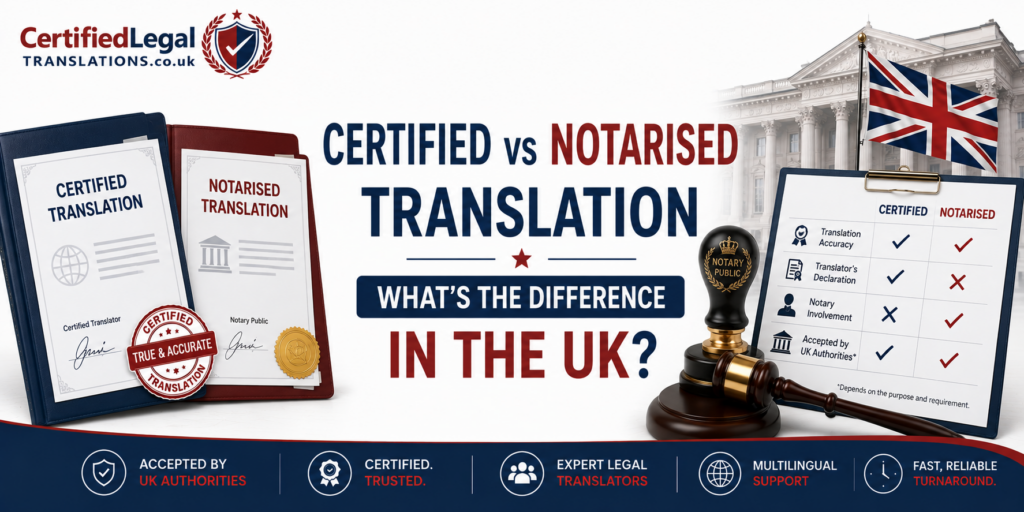
Confusion here costs real money on the wrong service. The UK has no sworn translator system in the continental sense. Instead, a properly certified translation is the standard route for domestic proceedings.
| Type | What it adds | Typical UK court use |
|---|---|---|
| Certified translation | Translator’s signed certificate of accuracy | The standard requirement for most civil, family and tribunal filings |
| Notarised translation | A notary verifies the identity of the signer — not translation quality | When a court, embassy or receiving body specifically asks for it |
| Sworn translation | Translator sworn before a court in a civil-law country | Not a UK domestic system; relevant when a foreign jurisdiction is involved |
| Apostille / legalisation | FCDO authentication for overseas use | Documents leaving the UK, not documents filed within it |
Paying for notarisation nobody asked for does not strengthen your filing. Rather, it adds cost and a day or two to your timeline. So where a directions order or a receiving body does specify it, order a notarised translation deliberately — and where the requirement is unclear, confirm the exact wording with the court or your solicitor before ordering anything.
How To Prepare A Certified Translation For Uk Courts Without Losing Time
Preparing a certified translation for UK courts is mostly a question of sequence. Here is the order our in-house specialists work in, and the reason behind each step.
1. Read what the court asked for, word for word. Directions orders sometimes name a format, a deadline or a specific certification level. Read the actual wording rather than assuming the general rule applies to you. A single line in a directions order overrides every general guide on the internet, including this one.
2. Send the complete document — all pages, front and back. Reverse sides carry stamps and endorsements far more often than people expect. Meanwhile, a translation that quietly omits them looks incomplete the moment a judge sets it beside the original.
3. Confirm name spellings against your passport or ID. Transliteration from Arabic, Cyrillic or Urdu can produce several valid English spellings of the same name. Your evidence bundle needs one consistent spelling on every page. Otherwise the other side gets an easy question about whether two documents describe the same person.
4. Get witness statements drafted in the right language first. If the witness does not speak English, both the original statement and the statement of truth must sit in their language. Fix this at the drafting stage. Repairing it later usually means starting the statement again.
5. Check the draft yourself before certification. You know your dates, addresses and family relationships better than any translator. For example, you will spot a wrong birth year in seconds. This is the cheapest correction point in the entire process, because nothing has been signed yet.
6. File the original alongside the translation. Submitting the English on its own is the quiet failure that catches out more litigants in person than anything else on this list.
7. Present it bundle-ready. Clean pagination and legible copies genuinely matter when a judge works through several hundred pages before your hearing.
✔ Your Before-You-File Checklist
- ✔ Certificate signed and dated
- ✔ Translator named, with contact details
- ✔ Original foreign-language document attached
- ✔ Names matched to passport or ID spelling
- ✔ Every page, stamp and seal translated
- ✔ The court’s own directions followed to the letter
Deadline this week? Send us the file and your hearing date. We will tell you today whether it is court-ready.
How We Prepare Court Translations, And What We Will Tell You Honestly
Every certified translation for UK courts we produce goes to a translator working into their native language with legal subject experience. A second pair of eyes then checks it line by line against the original. Because the errors that matter here are dates, numerals and name spellings — not style.
We will also tell you when you do not need us. If your directions order asks for something simpler or cheaper than you assumed, we say so before you order. And where a requirement genuinely varies between courts or tribunals, we say it varies rather than guess. Often the right answer in that moment is a two-minute call to the court office. Frankly, we would rather you make that call than pay us for a document that does not fit.
Certified Translation For Uk Courts: Frequently Asked Questions
Do Uk Courts Accept Certified Translations?
Yes. A certified translation for UK courts, supported by a signed certificate of accuracy, is the standard route for filing foreign-language documents in the courts of England and Wales. However, you must file the original document alongside it.
Who Can Certify A Translation For A Uk Court?
A professional translator or translation company certifies the work by signing a statement confirming its accuracy and giving their name and contact details. There is no single licensing body for translators in the UK. Consequently, CIOL or ITI membership, or an ATC-registered provider, is what most courts and solicitors look for.
Can I Translate My Own Document For Court?
No — not if you are a party to the case. A translation certified by someone with an interest in the outcome invites an obvious challenge to its impartiality. The same applies to a relative or a friend involved in the matter.
Does A Certified Translation For Court Need To Be Notarised?
Usually not. Notarisation confirms the identity of the person signing the certificate rather than the quality of the translation, and most UK civil filings do not require it. That said, check any directions order, because some tribunals, embassies and foreign jurisdictions do ask for it specifically.
What Happens If A Court Translation Is Rejected?
The court may give the document reduced weight or exclude it from the evidence, and the hearing can be adjourned while a compliant version is prepared. Costs consequences may follow for the party that filed the non-compliant material. In practice, the fix is almost always a corrected certificate and the original document, not a better translation.
Final Thoughts On Getting Your Certified Translation For Uk Courts Right
None of this is difficult. It is simply easy to miss, and the cost of missing it is measured in adjourned hearings rather than translation fees.
Over the years we have noticed something consistent. The documents that sail through are never the cleverest translations. Instead, they are the ones where the certificate is complete, the original is attached, and the format matches exactly what the court asked for. That is the whole game.
So if you are unsure which level of certification your case needs, or your directions order uses wording you cannot decode, we would rather look at it with you now than fix a rejection later.
Talk To Us Before Your Filing Deadline
Send us your document and your hearing date. We will confirm what your court expects, prepare your certified translation for UK courts to that standard, and return it ready to file — with the certificate wording, the original and the presentation all handled for you.
Every file is translated by a qualified linguist working into their native language, reviewed independently against the source, and certified with full translator details so the other side can verify it. We work to CIOL and ITI professional standards, handle every document under strict confidentiality, and keep your originals and drafts secure throughout.
You will get a fixed quote against your actual file — not a per-page guess — and a clear delivery time measured against your deadline rather than ours. If we think your directions order asks for something simpler than you assumed, we will say so before you pay.
➔ Get your court translation checked and quoted — upload your file, tell us your hearing date, and we will confirm exactly what your court needs.