The bundle is due in two days. Everything is scanned, indexed and paginated — except the Polish marriage certificate, the Arabic bank statements and the Urdu affidavit that came in as photographs.
This is where court bundle translation stops being a translation job and becomes a bundle-building job. A perfectly accurate English version can still break an electronic bundle: it will not search, the pagination drifts, and the judge cannot find the page you cite in submissions. At Certified Legal Translations, we prepare foreign-language material for hearing bundles across England and Wales every week, and the problems are almost never linguistic. They are technical.
Here is how to get translated material into an HMCTS-compliant e-bundle without losing your filing slot.
Quick Answer: What Hmcts E-Bundle Rules Mean For Translated Documents
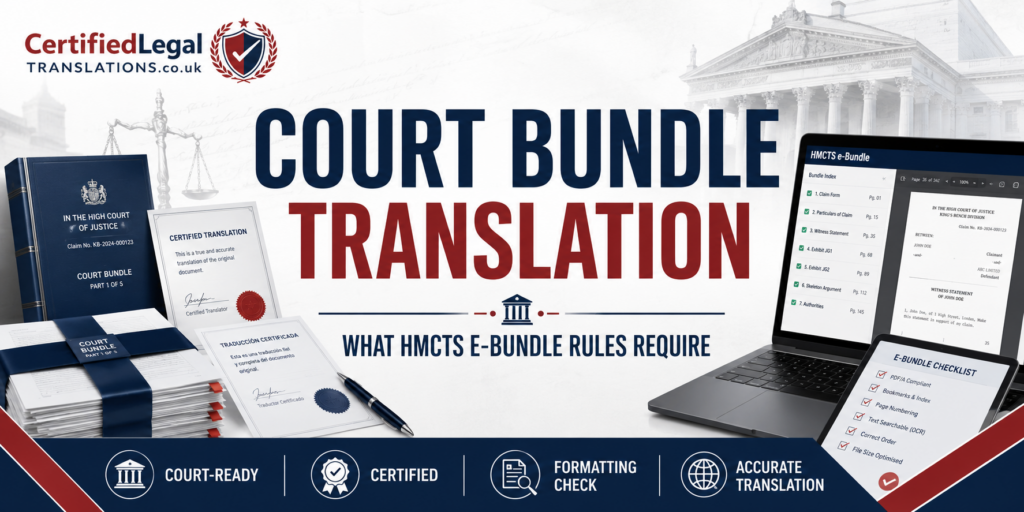
📌 Judicial guidance on electronic bundles applies to your translated pages exactly as it does to every other page:
- ✔ Every page containing typed text must be OCR’d if it was not created directly as an electronic text document — including the foreign-language original
- ✔ Numbering starts at page 1 and runs sequentially to the last page, so the pagination matches the PDF numbering
- ✔ Each index entry must be hyperlinked to the document it refers to
- ✔ Significant documents and sections must be bookmarked with a short description and the page number
- ✔ If a hard copy is produced, its pagination must match the e-bundle
➔ In short: a translation is not a separate deliverable you staple on. It is a set of bundle pages, and it must behave like one.
Where Translated Documents Go In A Court Bundle
Place the certified English translation immediately after its foreign-language original, inside the same section, running in the same continuous pagination.
Splitting them is the mistake we see most often — originals gathered in one appendix, translations in another. It is tidy on a desk and unusable on screen. A judge reading paragraph 14 of a witness statement should not have to jump 180 pages to check what the exhibit actually said.
How To Sequence And Cross-Reference Translated Exhibits
- Original first, translation second, then the certificate. The reader sees the source document, the English version, then the confirmation of accuracy. That order tells the whole story without explanation.
- Keep the translator’s certificate page inside the bundle, not in a covering email. Certification that is not paginated may as well not exist during a hearing.
- Name the index entry usefully. “Exhibit RK3 — Marriage certificate (Polish) with certified English translation” beats “Exhibit RK3” every time.
- Bookmark both versions separately so navigation works from either direction.
- Cite bundle page numbers in your skeleton and statements, not the document’s own internal numbering — the bundle number is the only one that exists in the hearing room.
💡 If your matter sits in the Family Court, the First-tier Tribunal or the Upper Tribunal, section structure and page limits differ from civil practice. Check your directions order before you build.
The Ocr Problem Nobody Warns You About In Court Bundle Translation
OCR is the single biggest technical failure point when foreign-language documents enter an e-bundle, and standard software rarely handles it silently.
Here is what actually happens. Your scanner reads a Latin-alphabet page cleanly. Give it Arabic, Urdu, Cyrillic, Greek, Thai or Chinese and, unless the correct language pack is applied, it either produces nothing or produces convincing nonsense that sits invisibly under the image. The page looks fine. The bundle passes a quick visual check. Then in the hearing, a search for the witness’s name returns nothing, and nobody can explain why.
Common triggers we correct:
- Photographs instead of scans — phone images taken at an angle rarely OCR at all
- Handwritten entries on civil registry certificates, which OCR cannot capture
- Ornate seals and stamps overlapping printed text
- Faint or second-generation photocopies of older documents
- Right-to-left scripts processed with a left-to-right language setting
Scanned resolution is generally expected to sit between 200 and 300 dpi — high enough for reliable character recognition, low enough to keep the file manageable. No page should appear upside down or sideways, and file size should be optimised.
➔ Practical fix: OCR the English translation properly and always, and treat the foreign-language original as an image page if it genuinely will not process. Note it in the index rather than leaving a silent gap. Where a translation is prepared as a native text document rather than a scan, it arrives searchable by default — which is exactly why we produce ours that way through our court document translation service.
Scan Quality And File Discipline For Foreign Language Documents In Court Bundle Work
Poor source files cost more time than difficult languages do. These are the standards worth enforcing before anything reaches a translator.
📌 One more discipline that saves hearings: transliteration consistency. A name rendered from Arabic or Cyrillic can produce several valid English spellings. If the passport says one thing, the witness statement another and the bank statement a third, you are inviting an identity challenge across your own evidence. Fix the spelling once, then apply it to every translated page in the bundle.
How To Plan Translation Around Your Bundle Lodging Deadline
Work backwards from the lodging date, not forwards from the day the documents arrive — that single habit prevents most bundle emergencies.
Here is the sequence our specialists recommend to solicitors and litigants in person alike:
- Audit the file for foreign-language material on day one. Not the week of the hearing. Count pages, list languages, flag anything handwritten or faint.
- Fix the source scans before translation starts. Re-scanning after translation means re-checking, re-paginating and re-indexing everything downstream.
- Agree name spellings up front against passports or identity documents, so every page in the bundle matches.
- Book translation to land at least three working days before lodging. That leaves room for your own check, pagination and index building — the stage that always takes longer than expected.
- Build the index and bookmarks last, once page counts are final. Translated pages are the ones most likely to shift a count.
- Do a search test before you file. Open the assembled PDF and search for three names and two dates. If nothing returns, your OCR has failed and you still have time to fix it.
✔ Pre-lodging check: originals and translations adjacent · continuous pagination matching PDF numbers · index hyperlinked · bookmarks descriptive · certificate pages included · search test passed · filename carries the case reference.
Why Our Approach To Court Bundle Translation Fits How Bundles Are Actually Built
We work to the deadline that matters, which is the lodging date rather than the hearing date, and we say so at quoting stage.
Every court file is handled by a translator working into their native language with legal subject experience, then reviewed line by line against the original by a second specialist. Our reviewers check dates, numerals and name spellings first, because those are the errors that damage evidence — style comes second. Where credentials matter to your bundle, we can confirm the qualifications behind the certificate, and we provide translations as native text PDFs so they arrive searchable without a separate OCR pass.
We will also be straight with you about limits. If a document is too faint to translate reliably, we tell you before we start rather than delivering a guess with a caveat buried in an email. If your directions order asks for something unusual, we would rather read it than assume. And if part of what you have sent does not need translating at all, we will say so — reducing your page count helps you more than it helps us.
Frequently Asked Questions About Court Bundle Translation And Hmcts E-Bundles
Do Foreign Language Documents Need To Be In The Court Bundle As Well As The Translation?
Yes. The foreign-language original and the certified English translation both belong in the bundle, placed together in the same section and covered by the same continuous pagination.
Does A Court Bundle Need Ocr If It Contains Scanned Foreign Documents?
Judicial e-bundle guidance requires pages containing typed text to be OCR’d where they were not created as electronic text documents. Non-Latin scripts often need a specific language pack, so verify by searching the assembled PDF rather than assuming the software succeeded.
Where Should The Translator’S Certificate Go In The Bundle?
Directly after the translation it certifies, as a numbered bundle page within the same section. Certificates sent separately by email are not part of the bundle and cannot be referenced during a hearing.
Who Is Responsible For Preparing The Bundle When Documents Need Translating?
The party lodging the bundle remains responsible, including for the compliance of translated pages. Litigants in person are expected to comply as far as possible, and to explain any difficulty to the court well before the hearing.
Do The Same E-Bundle Rules Apply In Scotland And Northern Ireland?
Not identically. HMCTS and Courts and Tribunals Judiciary guidance covers England and Wales, while Scotland and Northern Ireland operate separate systems — confirm bundle requirements with the relevant court.
Final Thoughts On Getting Court Bundle Translation Right First Time
Bundles rarely fail because a translation was wrong. They fail because a translated page could not be searched, could not be found, or was numbered differently from the copy in front of the judge.
Over the years we have found that the files which run smoothly are the ones where somebody asked about the foreign-language documents in week one instead of week eight. Everything after that is process — and process is easy when there is time for it.
If you are staring at a lodging date and a stack of documents in three languages, tell us what you have and when it needs to land.
Talk To Us Before Your Bundle Lodging Deadline
Send us the foreign-language documents from your file with your lodging date, and we will confirm what is workable, flag anything that needs re-scanning, and return translations ready to drop straight into your bundle — searchable, paginated cleanly, and certified.
➔ Send us your bundle documents for a same-day assessment — tell us your deadline and we will build the schedule around it.