⚡ Quick Answer: A foreign court order used in England and Wales needs a complete, certified translation carrying a signed statement of truth, the translator’s contact details, and every seal, stamp and marginal note rendered — not just the ruling itself. Whether it also needs an apostille depends on the receiving UK body, not the translation. Recognition (accepting the judgment as valid) and enforcement (recovering money or enforcing custody) are separate legal steps, each determining what gets filed alongside the translation. Scotland applies different certificate rules to England and Wales.
If you’re holding a custody order from Poland, a divorce judgment from Dubai, or a commercial ruling from India, and you need a UK court to act on it, a plain translation won’t get you far.
At Certified Legal Translations, we’ve sat across the desk from enough parents mid-custody dispute and solicitors chasing overseas debt to know a foreign court order translation UK case carries different weight to a birth certificate. A judge isn’t just reading the words — they’re deciding whether to recognise, enforce, or rely on a document from a legal system they’ve never worked under.
This guide sets out what happens once a foreign judgment lands on a UK court’s desk: which legal route applies, what the certification behind the translation needs to say, and where an apostille genuinely fits in — because it rarely fits where people assume.
📌 KEY TAKEAWAYS
- ✔ Translation alone changes nothing — confirm the recognition or enforcement route first.
- ✔ Family Court, civil courts and Scottish sheriff courts expect slightly different certification.
- ✔ An apostille authenticates the original judgment — it doesn’t replace the certified translation.
- ✔ Selective translations get rejected. Seals and marginal notes need rendering too, not just the ruling.
Why Does A Uk Court Treat A Foreign Court Order Translation Differently?
A birth certificate translation gets checked once, filed, and rarely revisited. A foreign court order translation UK submission doesn’t behave like that. The opposing party has every incentive to challenge the translation itself, not just the facts — because if its accuracy is doubted, the whole piece of evidence can be set aside with it.
That’s why a UK judge isn’t only checking for fluent English. They’re checking whether the certificate behind the translation would survive being questioned directly. A translator’s signed declaration on a custody order or foreign judgment carries genuine evidential weight here — treated closer to expert evidence than routine paperwork.
Recognition Or Enforcement: Which Route Does Your Foreign Judgment Need?
Before any translation gets commissioned, work out which of these you’re pursuing, because it changes what the receiving court wants attached to the file.
Recognition means a UK court accepts the foreign judgment is valid and won’t be relitigated here — the route most overseas divorce or custody rulings need. Enforcement goes further: it lets you use UK mechanisms — charging orders, attachment of earnings, third-party debt orders — to recover a judgment debt. Commercial parties usually need both. Family cases typically only need recognition, unless maintenance is involved, in which case enforcement follows too.
Family Court Orders: Custody, Child Arrangements And Cross-Border Divorce
Custody and child arrangement disputes spanning two countries usually sit under the Hague Convention on Child Abduction, or the older Brussels IIa framework for older cases. Either way, the Family Court’s expectation is consistent: a custody or divorce order gets translated in full, not summarised, carrying a signed statement of truth naming the translator.
What we frequently see catch families out is treating the order like any other personal document — sending only the final page with the ruling and leaving out the recitals or the judge’s reasoning. Family Court practice expects the entire order translated, filed alongside the original, wet-ink stamps included.
Civil And Commercial Judgments: Which Legal Route Applies
Enforcing a foreign commercial judgment in England and Wales runs down one of three tracks, each expecting something different from the translation package.
Where a reciprocal arrangement exists with the judgment’s country of origin, registration usually proceeds under the Reciprocal Enforcement of Judgments Act 1920 or the Foreign Judgments (Reciprocal Enforcement) Act 1933 — both treat the judgment as domestic once registered. For qualifying civil and commercial matters, the Hague Judgments Convention 2019 offers a more modern route; it came into force here on 1 July 2025, but only for proceedings issued from that date, so timing needs checking against your case.
Outside a reciprocal or Convention arrangement, the common law route treats the judgment as a debt, pursued through a summary judgment application. The court will still verify the judgment was final and wasn’t obtained by fraud — details your translation needs to render precisely, because these are exactly the points a defendant scrutinises.
Scotland Applies Its Own Rules — Don’T Assume England And Wales Practice Carries Over
If your order needs to go before a Sheriff Court rather than an English or Welsh court, the certification requirements shift. Scottish civil procedure lets the sheriff order a translation lodged alongside the foreign document, but the certificate needs different content — the translator’s full name, address and qualifications, not simply a signed statement of truth. Check which jurisdiction you’re filing in before commissioning anything; reusing an England-and-Wales-style certificate north of the border can trigger a query.
Does A Foreign Court Order Need An Apostille Before Translation?
This is where most confusion sets in. An apostille authenticates the original judgment — confirming the signature or stamp on it is genuine — issued by a competent authority in the country where the judgment was made, not by the FCDO. FCDO apostille legalisation works the other way round, authenticating UK documents for use abroad. Whether your order needs apostilling before it reaches us depends entirely on what the receiving UK body has asked for.
| Requirement | What It Confirms | Who Provides It | When You Need It |
|---|---|---|---|
| Certified Translation | The English wording is accurate and complete | UK-based translator or agency | Every foreign-language court order submitted to a UK court |
| Apostille (origin country) | The judgment or signature is genuine | The origin country’s own competent authority | Only if the receiving UK body specifically requests authentication of the original |
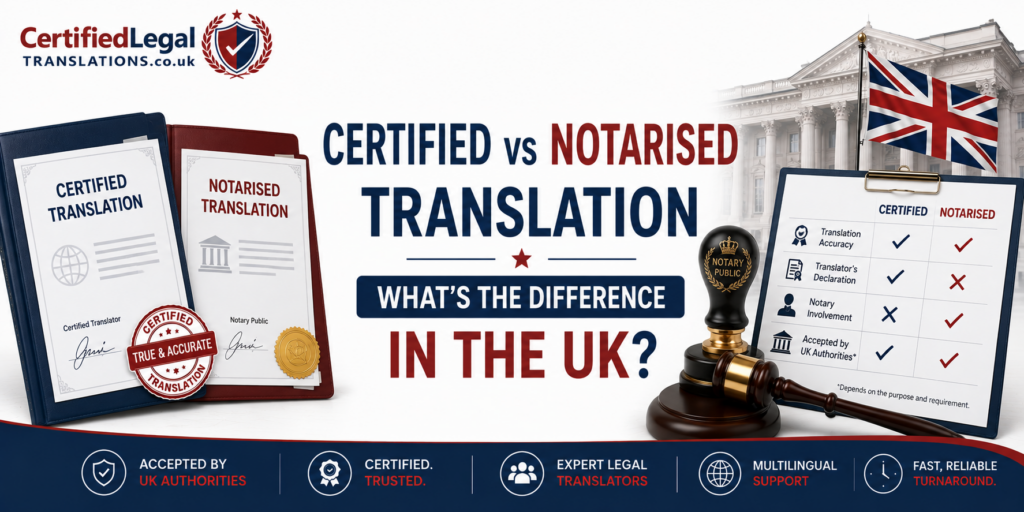
| Notarised Translation | The identity of the translator who signed the certificate | A UK notary public | Rarely needed for UK court use — more common for documents travelling abroad |
| Court Registration | The judgment is recognised or enforceable in the UK | High Court or relevant registry | Enforcement cases such as debt recovery or charging orders |
⚠️ CRITICAL LEGAL WARNING: We regularly see clients apostille a translation produced here in the UK, assuming it adds weight. An apostille on a UK-made translation means nothing to a UK court — apostilles authenticate documents for use in another country. Apostille the original judgment where relevant, never the translation of it.
What Must The Certification On A Foreign Court Order Translation Include?
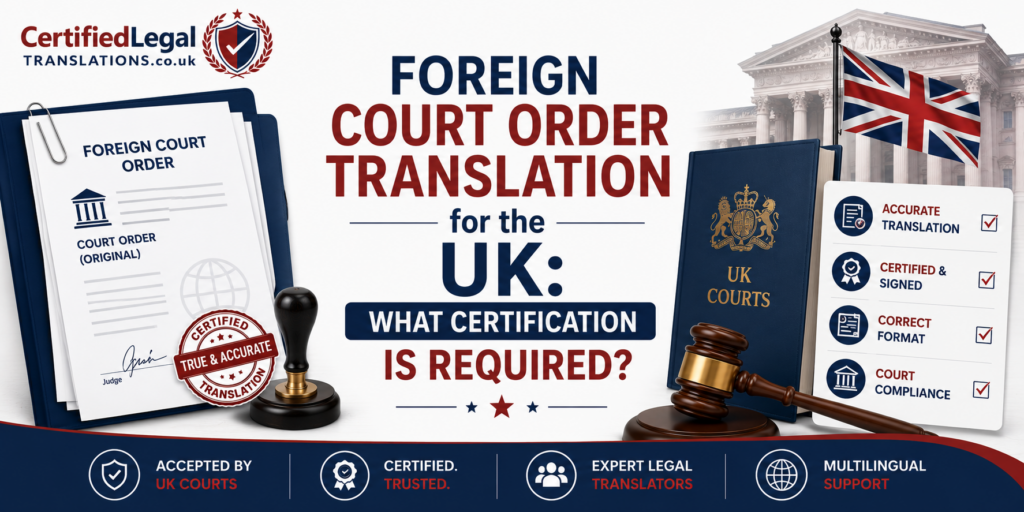
A UK court wants three things from the certification, and missing any one invites a query straight back. First, a signed statement of truth confirming the translation is accurate and complete — not a paraphrase. Second, the translator’s full name and contact details, so the court could verify who carried out the work. Third, completeness: every seal, stamp and marginal note on the original gets rendered, because a judge comparing both documents treats a gap as a red flag, not an oversight.
Our court document translation service is built around exactly this standard — complete, certified translations HMCTS, the Family Court and enforcement registries recognise without a second look, with same-day dispatch when a hearing date is close.
Getting Your Foreign Court Order Translation Right The First Time
Work through these in order — each one determines what the next step needs:
- 📌 Confirm the route first.
Recognition, enforcement, or evidential use each change what gets filed alongside the translation. - 📌 Check the receiving body’s exact requirement.
HMCTS, the Land Registry and a tribunal don’t always want the same paperwork for the same judgment. - 📌 Establish whether the origin country must authenticate it first.
Some judgments need apostilling in their country of issue before they’re usable here. - 📌 Commission a complete certified translation.
Every page, seal and note — not just the ruling itself. - 📌 File the original, any authentication, and the translation together.
A translation submitted alone, disconnected from its source, is far easier to challenge.
Frequently Asked Questions
Can Our Solicitor’S Own Paralegal Translate The Court Order Instead?
No — UK courts expect translations from an independent professional, not anyone connected to the case. An in-house version, however accurate, invites the same challenge a self-translated document would face.
Does A Certified Translation Of A Foreign Court Order Expire?
The translation itself doesn’t expire, but the court may want confirmation the judgment is still current — particularly for maintenance or custody orders that could have since been varied by a later ruling.
What Happens If The Other Side Challenges Our Translation’S Accuracy?
The court can pause proceedings while it reviews the disputed wording, sometimes requesting an independent second opinion. A certified translation from a recognised professional is far harder to successfully challenge than one without full certification.
Do We Need An Apostille And A Certified Translation For A Hague Child Abduction Case?
Not automatically — check with the central authority first. Many Hague applications proceed on a certified translation alone; apostilling is only needed where the specific court asks for it in writing.
Get Your Foreign Court Order Certified Translation Sorted
Every route above — recognition, enforcement, or evidential use — starts the same way: a complete, properly certified translation the court won’t need to question twice. Send us the judgment, tell us which UK court it’s going to, and our specialists will confirm exactly what certification — and if needed, what authentication — it needs before any work begins.
Send Your Court Order For A Certified Quote and we’ll come back with a turnaround time the same day.